1300 km through Italy sounds romantic. Until Italy has other plans.
The Italy Divide looks simple when you reduce it to numbers:
- 1300 km
- 22,500 meters of climbing
- Pompeii to Torbole
- 5 days and 15 hours
- 95.2 hours of riding time
- 6th place from the Pompeii start
But numbers are only the clean version.
The real story was rain, mud, headwind, pasta, hotel radiators, wet chicken nuggets, a Garmin that briefly lost its mind, brake pads worn down to metal, and a message from my daughter that hit harder than any climb.
This is my Italy Divide 2026 race report - day by day.
Honest, dirty, beautiful, and occasionally a little stupid.
Which is probably exactly why we do this.
The plan: do not become a hero on day one
My strategy was not complicated.
I wanted to ride controlled, keep most efforts below 200 watts, eat constantly, sleep properly, use hotels where it made sense, dry my kit, and repeat the same boring good decisions every day.
That sounds obvious.
But in an ultra bikepacking race, obvious things become hard very quickly:
- do not chase faster riders too early
- do not skip food because you feel good
- do not ignore cold weather because you are "almost there"
- do not let one bad hour become one bad day
The Italy Divide rewards patience.
And it punishes ego.
Travel day: Zurich to Pompeii
The trip started in Zurich with the usual bike-travel ritual:
Pack the bike, check the luggage, and quietly hope the airline does not send your race setup into another dimension.
In Naples, my bike bag arrived first, which was suspiciously smooth. Then came the taxi ride to Pompeii, where I was probably charged the full tourist education fee. Still: bike there, rider there, hotel there.
Good enough.
I had one day to settle in, eat, sleep, register, and look at other bikes.
And that is one of the best parts of these events. Gravel bikes, full suspension bikes, minimal setups, overloaded setups, tire discussions with the seriousness of international diplomacy - for bikepacking people, this is basically a Christmas market with more carbon and less mulled wine.
Everyone looks relaxed.
Everyone is nervous.
Everyone is secretly wondering whether they packed too much, too little, or the wrong snack.
Day 1: Pompeii to Castel di Sangro
210 km / 3,700 m climbing
The start was full of energy, but I kept repeating one rule to myself:
Do not overpace.
The climb up Vesuvius was a perfect opening. Beautiful, rideable, dramatic in exactly the right way. The descent was less romantic: buses, cars, traffic, and a few moments where "interesting" became a polite word for "slightly criminal".
After Naples, the race finally opened up.
And then the headwind arrived.
Straight from the north, straight into the face, with the personality of someone who had a problem with my life choices. The first 100 kilometers were slow, around 18 km/h average, but that was okay. This was not the moment to fight the wind with stupid watts.
Fueling was pure ultra logic:
- chips
- ice cream
- gas station food
- McDonald's in Isernia
- three burgers
- nuggets and a wrap for later
The plan was brilliant until I put my backpack with the hydration bladder sideways while changing clothes. Water leaked into the bag.
The result:
Wet chicken nuggets. Wet wrap. Zero Michelin stars.
At around 23:00 I reached Castel di Sangro. It had become cold, I needed my insulation jacket while riding, and the final descent included steep, rough sections and a bit of pushing through bushes.
Not exactly what you dream of after 200 kilometers.
But then came the hotel.
Radiator. Drying kit. Warm toast with ham from the owner at 23:00.
At that moment, it was not toast.
It was salvation.
Day 2: Abruzzo to Rome
266 km / 4,000 m climbing
I started late by race standards, around 07:00, because breakfast was worth it. Muesli, croissants, espresso - not weakness, strategy.
The Abruzzo mountains were incredible.
Cold air, wild landscapes, snow on the peaks, and near Monte Piselli the highest point of the race at almost 2,000 meters. These are the moments that explain everything without needing a speech.
On the descent I met a herd of chamois, and later Lorenzo, a strong Italian rider doing the Pompeii route for the second time. We rode together toward Lago di Scanno, which from above looks like a heart.
Yes, Italy can be cheesy.
But sometimes good cheesy.
After panini in a bar, we continued toward Rome. Lorenzo got a sidewall cut in his Maxxis tire, which we fixed with tape. My electric pump brought it back to pressure quickly, and that little pump slowly started its campaign for MVP of the race.
Then the route near Rome decided to become creative.
Along the Aniene, we ended up on difficult trails, over fallen trees, around an abandoned car, and finally at a two-meter-high barbed wire fence.
Dead end.
That kind of thing is brutal when you are tired and hungry. You are thinking about pizza, and suddenly the route says: no, please go back and spend more mental energy.
We finally reached Tivoli around 22:00 and ate pizza.
But the day still was not finished. Another 30 kilometers toward Rome, a late B&B booking, friendly dogs, and the Via Appia Antica - beautiful history, terrible surface for a tired backside.
We arrived around 01:00.
Day two was a masterpiece of beauty, hunger, and unnecessary fencing.
Day 3: Rome to Ponte a Rigo
214 km / 4,100 m climbing
We started at 06:00 with three big sweet Italian brioche and two espresso.
Textbook? Probably not.
Ultra logic? Absolutely.
The route moved into Tuscany, and Tuscany made one thing very clear: every town is on top of a hill.
Not beside the hill. Not around the hill. On top of it.
Thank you very much.
The day was steep up, steep down, with trails, effort, and very few free kilometers. Lorenzo started having knee problems before Viterbo, near Lago di Vico, so our ways separated.
I had booked a B&B about 200 kilometers from Rome and really wanted to reach it.
Physically, I felt good again. I could ride around 200 watts uphill, the legs were there, the head was there, and Lidl in Viterbo was open. That was a small miracle because it was May 1 and the city was full of people.
After Viterbo, the pattern continued:
Climb into town. Descend out of town. Repeat until the map starts to feel personal.
The B&B took forever to arrive, but once again the hospitality was amazing. Warm toast, salad, mozzarella.
In a race like this, a warm meal can repair your entire worldview.
Day 4: Ponte a Rigo to Impruneta
186 km / 4,200 m climbing
Breakfast was again at 07:00, which is late for racing, but I happily took the sleep.
I started fueled and relatively calm.
Except my thigh muscles were completely locked up.
Pain everywhere.
And then I remembered the one thing I had forgotten at home:
Perskindol.
That was the mistake of the race.
I did not want to take painkillers. Ibuprofen during very hard endurance efforts is not something I want to rely on, and it does not fix the actual problem anyway. So I stretched, ate, stayed calm, and hoped the legs would come back.
After some proper stretching and a panini, they did.
I could push again, but I knew I would not reach Florence that day. The profile was too hard to read, with endless steep little ups and downs. So after Siena I booked a hotel near Impruneta.
And then came another perfect Italy moment.
The restaurant was still open.
Spaghetti, meat, beans.
After a day like that, dinner does not simply taste good. It tastes like a religious experience.
Day 5: Impruneta to Sasso Marconi
146 km / 3,000 m climbing
I wanted to leave at 06:00 and gamble on breakfast in Florence or Prato.
At reception, another rider was waiting: Giona.
He had started from Bari and had waited because the weather forecast over the Apennines looked rough: thunderstorms, rain, wind. He did not want to cross alone.
That was smart.
Some bad decisions are better shared.
It was already raining hard when we left toward Florence. Soon after, Giona punctured his Schwalbe G-One on a piece of glass. We fixed it with a tire plug, used the electric pump again, and two minutes later the bike was ready.
MVP campaign getting stronger.
The first climb out of Prato was steep and nasty. Lots of hike-a-bike, rocky singletrack, and a trail that looked more like a stream than a trail.
At the top, we met frozen riders coming the other way and decided to move quickly toward a bar in Vernio. Other riders were already inside. We entered with wet clothes and muddy shoes and probably changed the floor color forever.
Coffee Americano, croissants, panini.
Life returned.
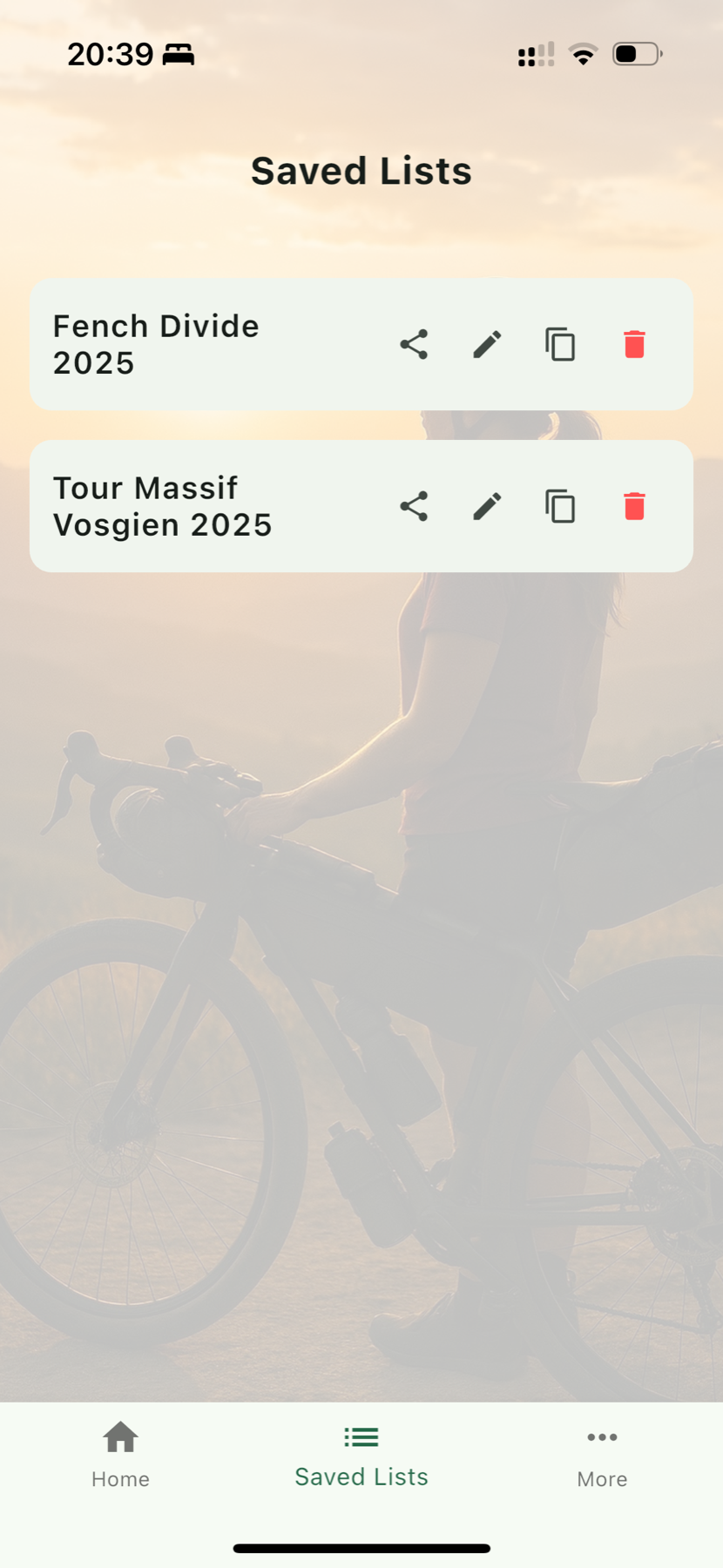
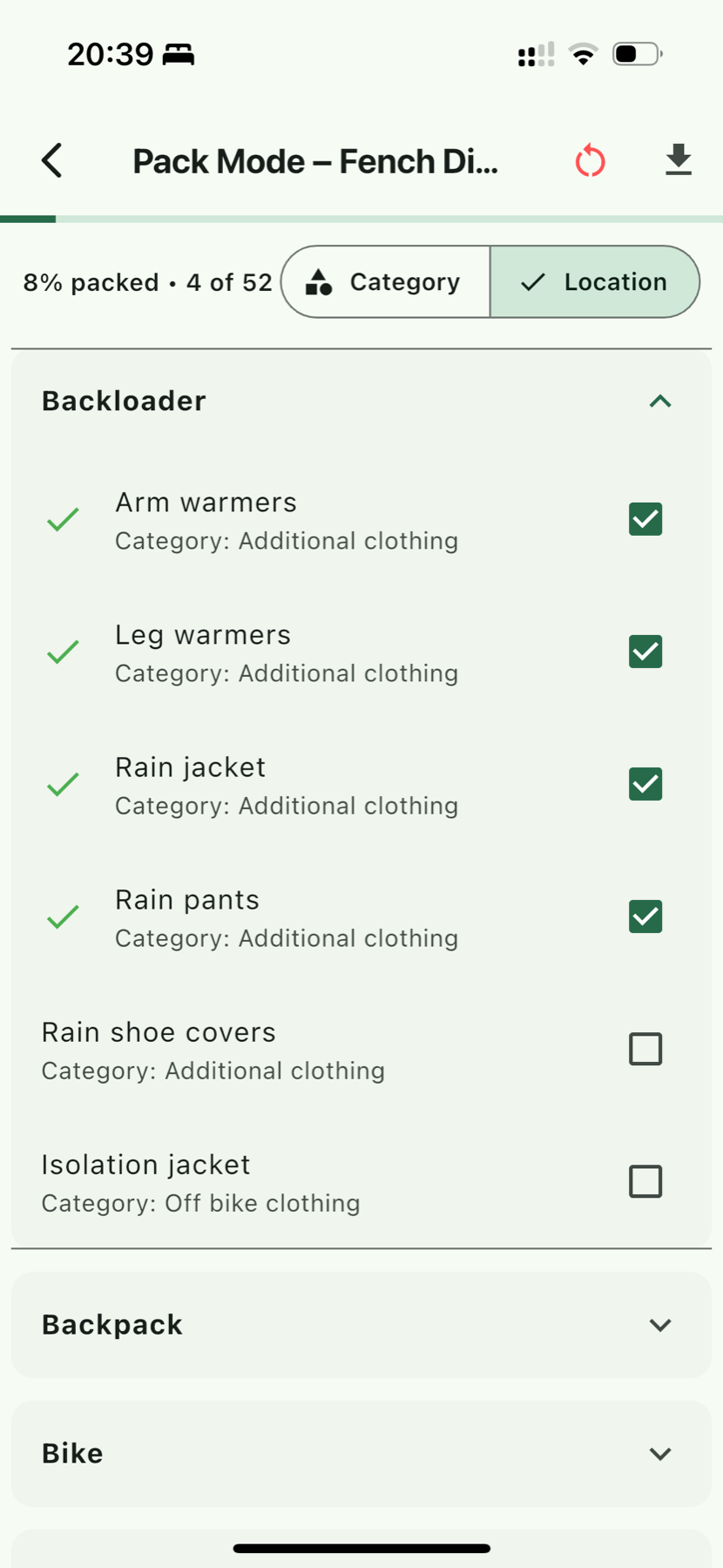
There I met Nicola, who knew me from the YouTube channel and had downloaded my bikepacking app to prepare for the race. That was a genuinely cool moment. When a small project meets real people out on the route, it suddenly feels much bigger.
Ciao Nicola - it was great to meet you.
After that, the weather improved, even the sun came out, but the route did not get easy. We wanted to move toward Bologna, but progress stayed slow:
- steep kickers
- rocky trails
- sticky peanut-butter mud
- endless little climbs
- tired legs
It was not a record day in distance or climbing, but we were still on the bike for around 16 hours.
In Sasso Marconi, we booked a hotel.
Pasta, fries, dessert, sleep.
The plan: start the final stage at 04:00.
The final stage: Sasso Marconi to Torbole
The hotel owner was amazing.
He got up with us and made breakfast at 04:00. We ate everything we could, but it still took effort to leave because outside it was raining heavily.
Bologna was soaking wet. Roads were almost flooded.
And then my Garmin started restarting again and again.
That was real panic.
I was lucky I could sit on Giona's wheel because for a short moment I was basically blind. I stopped the route and restarted it, and thankfully everything came back. But that moment stayed with me.
A backup Garmin suddenly sounded less ridiculous.
Yes, a phone or watch can be an emergency solution, but in rain, fatigue, and low battery situations, I do not want my race depending on improvisation.
After Bologna, we wanted to stop at a bar.
Before we got there, I crashed on a slippery underpass.
Luckily, I was not injured, but mentally it went deep for a moment. It reminded me of my crash in the Vosges, where a similar mistake ended my race. Those memories do not need much space to come back.
Then came the long, straight, monotonous section toward Verona.
Mentally, it became brutal.
We were almost falling asleep on the bikes, so we stopped for a five-minute power nap on a bench.
Five minutes.
And somehow it felt like rebooting the system.
Suddenly the brain was back online.
I did a lot of pulling because Giona's knee was hurting, and we wanted to reach the finish together. But between Verona and Torbole there were still around 2,200 meters of climbing.
In Verona we refueled.
Then came the final climbs.
Steep again. Hiking again. That strange feeling again: how can there still be this much mountain left?
At some point I realized:
This is the last climb.
The whole thing is almost over.
I tried to absorb every minute. Every second. I was destroyed, but also deeply aware that these are the moments you cannot buy, fake, or fully explain later.
Then I checked my phone and saw a message from my daughter.
And that completely broke me open.
This is the emotional side of ultra racing that is hard to describe. You are empty, tired, cold, and somehow more present than in normal life. A small message can hit harder than a whole mountain pass.
The weather got worse near the top. It became colder, we saw lightning, and unfortunately it was dark by the time we reached the descent. We put on everything we had to avoid getting too cold.
I missed the warm gloves I had left at home.
Bad decision number two.
On the way down, we also had to change Giona's brake pads. On the final steep meters he was basically braking metal on metal.
Let us call that "not very safe" and move on diplomatically.
The last 24 kilometers to Torbole were still hard. Light rain, empty legs, tired heads, but the finish was close.
Around midnight, we arrived.
Giacomo was there at the finish.
I was done.
Completely done.
And very, very happy.
What worked
The bike was absolutely the right choice for me.
My drop bar full suspension MTB with fast tires gave me exactly the balance I wanted: efficient enough on the road, much more relaxed and safe on rough trails, descents, and bad weather sections.
Could you ride this race on a gravel bike?
Of course.
Would I choose that for myself?
No.
For me, the Italy Divide is not a pure gravel route. There are too many trails, rough descents, wet sections, and moments where comfort becomes speed because it keeps the body and mind functioning.
Hotels also worked very well.
Especially with rain and cold weather, proper recovery matters:
- dry clothes
- warm shower
- real sleep
- breakfast
- somewhere to reset mentally
There were enough places along the route, and I never felt that the hotel strategy was a limitation.
It was part of the performance.
What I would change
Three things:
- Bring Perskindol.
- Bring warm gloves.
- Use drybags or separate bags for food.
The wet chicken nugget situation was unnecessary.
It was not heroic.
It was just bad logistics.
And after 1000 kilometers, small comfort items stop being small. Warm hands, relaxed muscles, dry food - these things can decide whether you stay efficient or start making expensive mistakes.
Favorite item of the race
My favorite piece of gear was not the most emotional one.
It was not the lightest.
It was not the most beautiful.
It was the electric pump.
At Lorenzo's sidewall cut and Giona's puncture, it saved time, energy, and patience. In a race like this, you do not want to stand on the side of the trail forever, pumping by hand, getting cold, getting annoyed, and watching the day disappear.
You want to fix the issue, put pressure in the tire, and continue.
That is exactly what it did.
Small item.
Big effect.
Final thoughts
The Italy Divide is hard in a way that is difficult to summarize.
It is not just the distance. It is not just the climbing. It is not just the weather.
It is the constant negotiation between body, route, equipment, sleep, food, fear, beauty, and stubbornness.
There were moments where I was cold, tired, annoyed, and mentally empty.
There were also moments where I thought:
This is exactly where I want to be.
That is the strange magic of ultra bikepacking.
Completely unreasonable.
Deeply meaningful.
And somehow, once you finish, already a little bit tempting again.
Related links
Watch the video version: Italy Divide 2026 Race Report
My packing list app: bike-packing.app
My Italy Divide 2026 setup: My Italy Divide Setup 2026
My Italy Divide packlist: Italy Divide 2026 packlist
Contact me for support: support@bike-packing.app